Hasegawa [PT13] 1:48 F-86F-30 Sabre U.S. Air Force
The F-86 Sabre was developed as a jet fighter to succeed the P-51D Mustang. The prototype XP-86 made its maiden flight on October 1, 1947.
The F-86E was an improved version of the initial production model F-86A. It was equipped with the J-47-GE-13 engine and had improvements in its control systems and a movable horizontal stabilizer. Lessons from aerial combat with the MiG-15 in the Korean War led to further modifications.
This resulted in the F-86F, which first flew in March 1952. It used the J-47-GE-27 engine, producing a thrust of 2,760kg. The armament included six 12.7mm machine guns, and provisions were made to attach various missiles or bombs under the wings. Bulletproofing was enhanced, and during production, leading-edge slats were removed, the chord was slightly extended, and boundary layer plates were added to prevent wingtip stalling. This resulted in the F-86F-25 and -35.
As a result, the F-86F demonstrated superior dogfighting capabilities to the MiG-15 and achieved great success in the latter stages of the Korean conflict. Subsequent evaluations showed that combining the chord-extended wing (commonly referred to as the 6-3 leading-edge wing) with leading-edge slats provided better maneuverability at all speeds, so the slats were reintroduced. This model is known as the F-86F-40.
The Japan Air Self-Defense Force adopted the F-86F-40 as its mainstay from 1956. Mitsubishi Heavy Industries localized production, primarily focusing on this later version with leading-edge slats. However, a few aircraft received from the US Air Force prior to this were of the older design with boundary layer plates. Some of these were modified in Japan to the leading-edge slat type, like the RF-86F. Over 330 F-86Fs were provided to the JASDF, including those given by the US military, those produced from knockdown kits, and those produced under license by Mitsubishi.
Data (Mitsubishi F-86F)
- Crew: 1
- Wingspan: 11.32m
- Length: 11.45m
- Height: 4.5m
- Maximum Takeoff Weight: 9,219kg
- Engine: J-47-GE-27 turbojet (output 2,681 horsepower)
- Top Speed: 1,118km/h
- Armament: Six 12.7mm machine guns, two Sidewinder air-to-air missiles, or six 0.5-inch air-to-air rockets, or two various types of bombs.
Original: $36.56
-65%$36.56
$12.80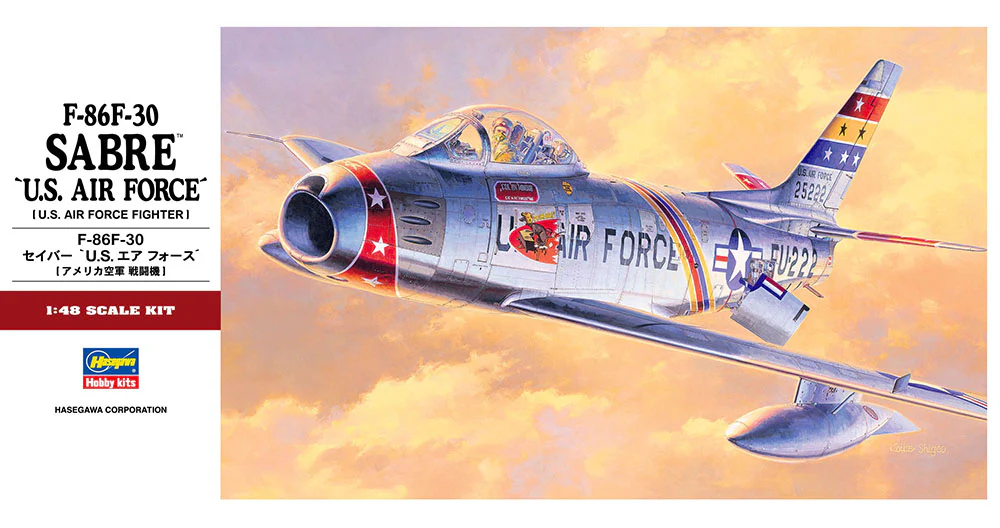

Description
The F-86 Sabre was developed as a jet fighter to succeed the P-51D Mustang. The prototype XP-86 made its maiden flight on October 1, 1947.
The F-86E was an improved version of the initial production model F-86A. It was equipped with the J-47-GE-13 engine and had improvements in its control systems and a movable horizontal stabilizer. Lessons from aerial combat with the MiG-15 in the Korean War led to further modifications.
This resulted in the F-86F, which first flew in March 1952. It used the J-47-GE-27 engine, producing a thrust of 2,760kg. The armament included six 12.7mm machine guns, and provisions were made to attach various missiles or bombs under the wings. Bulletproofing was enhanced, and during production, leading-edge slats were removed, the chord was slightly extended, and boundary layer plates were added to prevent wingtip stalling. This resulted in the F-86F-25 and -35.
As a result, the F-86F demonstrated superior dogfighting capabilities to the MiG-15 and achieved great success in the latter stages of the Korean conflict. Subsequent evaluations showed that combining the chord-extended wing (commonly referred to as the 6-3 leading-edge wing) with leading-edge slats provided better maneuverability at all speeds, so the slats were reintroduced. This model is known as the F-86F-40.
The Japan Air Self-Defense Force adopted the F-86F-40 as its mainstay from 1956. Mitsubishi Heavy Industries localized production, primarily focusing on this later version with leading-edge slats. However, a few aircraft received from the US Air Force prior to this were of the older design with boundary layer plates. Some of these were modified in Japan to the leading-edge slat type, like the RF-86F. Over 330 F-86Fs were provided to the JASDF, including those given by the US military, those produced from knockdown kits, and those produced under license by Mitsubishi.
Data (Mitsubishi F-86F)
- Crew: 1
- Wingspan: 11.32m
- Length: 11.45m
- Height: 4.5m
- Maximum Takeoff Weight: 9,219kg
- Engine: J-47-GE-27 turbojet (output 2,681 horsepower)
- Top Speed: 1,118km/h
- Armament: Six 12.7mm machine guns, two Sidewinder air-to-air missiles, or six 0.5-inch air-to-air rockets, or two various types of bombs.